Showing posts with label 2013. Show all posts

Sunday, 16 June 2013

2013 Cadillac ATS Review

Prying satisfied customers out of their Audi A4s, BMW 328s, and Mercedes-Benz C350s might seem tougher than establishing democracy in Afghanistan, but conquest sales will have to play a huge role in the success of the new Cadillac ATS. The brand desperately needs a successful entry luxury car because that’s the bestselling segment in the premium-car world. And since Cadillac has been moving in a sporting direction, it’s taking on these European sedans rather than targeting real-estate-agent buggies like the Lexus ES or Lincoln MKZ.

2013 Cadillac ATS
2013 Cadillac ATS

Off to a Good Start

We went into deep detail on the ATS earlier this year and were impressed with its design and engineering. Based on the brand-new Alpha platform, the 2013 ATS features a front-engine, rear-drive layout; four-wheel independent suspension; the latest ZF electric power steering; and four-wheel disc brakes. Motivation comes from a choice of three engines, with an available manual transmission, and optional all-wheel drive. It’s all wrapped in modern and attractive sheetmetal styled with a softer take on Cadillac’s Art and Science design philosophy. The whole shebang is 8.5 inches shorter than the CTS. We got a chance to drive it last month, and now we can finally tell you about it.

2013 Cadillac ATS front three quarter

From behind the wheel, the ATS makes an excellent first impression, with a good driving position combined with superb sightlines delivered in part by reasonably thin A-pillars. Models with sport seats have adjustable thigh support as well as adjustable side bolsters. You can choose from among seven interior color and finish schemes, including ones with aluminum trim and genuine carbon fiber. The ambience feels stylish and rich, and we were immediately able to find a comfortable driving position.

2013 Cadillac ATS review front angle

Good visibility extends to the information displayed to the driver, although the tachometer is tucked a bit far to the left on the instrument cluster and can fall out of your vision when driving hard. A head-up display is available, and there are three customizable windows below the central speedometer that can be configured using a large toggle switch on the right steering-wheel spoke; the control can be manipulated easily without looking down at it. Another toggle on the left spoke operates the cruise control.

2013 Cadillac ATS Concept Ca

The 8.0-inch LCD touch screen for the new CUE (Cadillac User Experience) system looks great and remains highly visible even when hit by direct sunlight. It has a number of clever features, such as a function that only brings up additional buttons when a proximity sensor detects your hand nearby. This allows the screen to stay uncluttered most of the time. You can change the map scale by squeezing or spreading your fingers as you do on a smartphone, and the nav system can pull contact addresses directly from a paired phone. We appreciate not having to manually enter an address that already exists in a connected device.

Overreaching Engine Lineup

2013 Cadillac ATS Review
2013 Cadillac ATS Interior

We first drove an ATS with the base engine, a 202-hp, 2.5-liter four-cylinder with direct injection. It’s basically a slightly updated version of Chevy’s workhorse engine and is available only with a six-speed automatic and rear drive. This engine won’t generate envy among any Audi or BMW owners. It delivers no better than adequate performance (claimed 0 to 60 in 7.5 seconds, which we think is about right on the nose), and it feels slower than it is—the transmission resists downshifting as you toe the throttle. The big four-cylinder is fairly loud at high revs. Were we in charge at Cadillac, we would have introduced the ATS without this engine and then slipped it into the lineup several months down the road if a less expensive entry-level model were deemed necessary.

Monday, 10 June 2013

2013 Bentley Continental GT Speed

In my mind it’s a Fiat Punto, but I really have no clue exactly which variety of vehicular mailbox pulled out into the left lane to pass the commercial truck. I remember that the truck had a cartoon of a hot dog with eyes. This was troubling for several reasons, including the fact that I’m not entirely sure it was a hot dog—where I come from, hot dogs don’t have that little tiara of casing material on the top of their “heads.” But, hey, they have their own kind of wieners in Germany, so I don’t know. But this imposition by the possible Punto was primarily troubling because my co-driver and I were going about 100 mph faster than that shitbox in a 616-hp, two-and-a-half-ton, quarter-million-dollar Burnt Orange Bentley Continental GT Speed, in the very lane of the A8 autobahn it seemed to now be parked in.

2013 bentley continental GT speed and continental GT3 concept photos 1280x782
2013 Bentley Continental GT Speed and Continental GT3 Concept Photos

I tried to remember what the Bentley guy said the previous day about the GT Speed’s brakes, something about them arresting enough energy at full clamp from the car’s 205-mph top speed to power six houses for an hour. Or maybe it was one house for six hours. Would that be any different? And wouldn’t the one (or six) homeowner(s) be better off just using the heat generated by the brakes to warm the house and power the TV with, say, 18 German shepherds on a huge wheel? We were probably driving about 170 mph, so that would be, like, only four houses/hours.

2013 Bentley Continental GT V8 front end in motion

2013 Bentley Continental GT V8 front three quarter in motion

Anyway, we seemed to have a great deal of time to get our numbers very wrong, since the Punto appeared at first as more of a surprising but emotionless blip on our consciousness. We didn’t really seem to be going that fast, but the Punto was getting too large, too quickly. Then…BRAKES! At that point, the big Bentley went all buns up and swaying—very disquieting. And then, well, then nothing. We didn’t die. Nobody was going to get to scavenge the turned-aluminum sunglasses case (a $470 option) or shattered portions of the monstrous carbon-ceramic brake discs ($13,600) out of the debris field on that particular day.

2013 Bentley Continental GT V8

We’d flown halfway around the world for stretches of road like this one south of Munich. Where else could we test the aptly named GT Speed but on the “derestricted” portions of the autobahn? The thing is a speed sled, a huge metal fist punching at the atmosphere (and wayward Puntos) with 12 cylinders and two turbochargers. Where, outside of a specialized test track, could we confirm that the GT Speed could reach 205 mph, a precious and highly theoretical 7 mph faster than the standard GT W-12 coupe (to be known henceforth as the GT UnSpeed)? With only occasional limit-free stretches of highway, though, we admit we never even matched the top speed of the convertible GTC W-12, a measly 195 mph, which is not even 200 mph. We got to 188 mph, which is plenty damn fast, as it turns out.

Monday, 3 June 2013

2013 Audi R8 e-tron Concept

After the E-tron concept and the E-tron Detroit Show car, Audi has brought us the e-tron technology platform based on the R8 from the 24 Hours of Le Mans race. This has turned out to be more than just a publicity stunt or science experiment. Audi is serious about bringing this car to market and has taken the time to develop a completely new ideology behind this electric R8 and the normal gasoline version.

2013 Audi R8 e-tron Concept
2013 Audi R8 e-tron

Having the exterior design of the car already completed and in supercar form it was an easier job for the Audi engineers to develop an electric version than if they would have had to start from scratch. The mid-engine design of the R8 provides the perfect location to store heavy batteries without distorting the weight balance that Audi wanted to achieve. In essence, this electric version should be able to compete on the same levels as its V8 and V10 brothers, but will it be as exhilarating?

2013 Audi R8 e-tron Concept
2013 Audi R8 e-tron

2013 Audi R8 e-tron Concept
2013 Audi R8 e-tron

2013 Audi R8 e-tron Concept
2013 Audi R8 e-tron


That all depends on what the driver sees as excitement – The V10 version will provide an unbridled amount of power and harmonious soundtrack to go along with it, but the electric version will incorporate some of the most innovative technology available today. Being able to reach high top speeds in the least amount of time is the most important thing that a sports car can deliver, if it can do it by using batteries than we don’t really see a problem. If Audi can truly create an exciting Quattro experience with its new E-Tron R8 than they will have accomplished something truly special in this emerging market.

Friday, 24 May 2013

BMW Pininfarina Gran Lusso Coupe

The 2013 Concorso d’Eleganza Villa d’Este kicks off this weekend, and BMW has once again unveiled a concept car for the prestigious Italian car show. Called the Gran Lusso Coupe, the vehicle was built in partnership with Italian design house Pininfarina. According to BMW, the concept marks the first time the two companies have paired together, and the coupe showcases the best each company has to offer in “style, dynamics, and aesthetics.”

BMW Pininfarina Gran Lusso Coupe

BMW didn’t specify what car the Gran Lusso Coupe is based on, but from the outside it looks like a 7 Series morphed into two-door form. Power comes from a V-12 powerplant, further hinting that its roots stem from BMW’s flagship sedan. That said, the large coupe sits on a long wheelbase, which contributes to its commanding presence, a sharp contrast to the smaller, two-seater BMW Zagato Coupe unveiled at last year’s show. The front end still sports the familiar BMW design cues like the dual-kidney grille and quad-round headlights. Additionally, the Gran Lusso Coupe features the automaker’s Air Breather aerodynamic system, which first debuted on the 4 Series coupe concept.

BMW Pininfarina Gran Lusso Coupe Concept

From the side, the coupe features a sloping roofline, large 21-inch wheels, short overhangs, and the requisite Hofmeister kink. A chrome accent strip engraved with the “Gran Lusso” logo is found between the front fender and door, while a “Pininfarina” badge is affixed immediately behind the Hofmiester kink. The rear end is fairly simple, with a sleek, single-unit taillight bar that wraps around the fender and rectangular exhaust tips integrated into the lower bumper.

BMW Pininfarina Gran Lusso Coupe Concept front view

BMW Pininfarina Gran Lusso Coupe Concept left rear view with driver

Inside, passengers are surrounded in brown leather seating surfaces and a black headliner made from Italian virgin wool. A fixed-glass moonroof cuts across the center of the roof that is also illuminated by LED accent lighting at night. BMW claims the kauri wood accent pieces, which were sourced from New Zealand, are more than 48,000 years old. Other interior trim pieces include black chrome, patterned leather piping on the seats, and a sporty, three-spoke steering wheel.

2013 Renault Twin-Run Concept

The rumors were true: Renault’s new Twin’Run concept, which debuted today at the Monaco Grand Prix, does channel the spirit of the wild Renault 5 Turbo rally car of the 1980s.

Renault has hinted that the Twin’Run ties in with a string of concept cars dating back to the 2010 De’Zir, but this latest concept has more in common with the Twin’Z show car unveiled earlier this year. Although that car was a five-door battery-electric vehicle, it still drew its inspiration from the old Renault 5 subcompact. The Twin’Run – which bears a close resemblance to the Twin’Z – does the same, but specifically the 5 Turbo: a rear-engined, Alpine-assembled monster originally created for Group B rally racing.

Renault Twinrun Concept

The Twin’Run’s shape and surfacing is almost identical to the Twin’Z, but a little more muscular and aggressive. The front fascia boasts a large, open lower air intake, and is topped with four square LED driving lights. The 5 Turbo’s blistering rear fenders are nowhere to be found, but large air intakes are tucked into the C-pillars, giving a hint to its mid-engine configuration.

Renault TwinRun Concept Front Three Quarters View on Track

With the exception of the carbon fiber roof and wheel wells, the Twin’Run’s bodywork is fabricated out of fiberglass and then draped upon a bespoke tube-frame chassis. That framework is especially evident within the interior, despite Renault’s attempts at dressing up the cabin. A rounded, white instrument panel echoes the shape of the original R5 Turbo’s but boasts a large, multi-function LCD panel that replaces most mechanical gauges. The dashboard and door panels are trimmed in red Alcantara, while the bucket seats use the same faux-suede albeit in three different shades. Vive les 80s.

Renault TwinRun concept side view

The cockpit is separated from the engine compartment by means of a plexiglass panel located just aft of the front seats. Unlike the R5 Turbo, the Twin’Run doesn’t use a small four-cylinder engine – or, for that matter, forced induction. Instead, Nissan’s VQ35 3.5-liter V-6 – the same engine found once found in the 350Z and Infiniti G35 — is planted amidship, and mated with a six-speed sequential gearbox. Power is then routed through a limited-slip differential to the rear wheels.

Renault Twin'Run Concept

Renault says the 3.5-liter V-6 serves up 320 hp and 380 Nm of torque. That sounds somewhat pedestrian until you consider the Twin’Z is almost the exact same size of a Fiat 500, and tips the scales at 2100 pounds – 400 pounds less than a 500 Abarth. That crazy power-to-weight ratio allows for a 0-62 mph time of 4.5 seconds and a top speed of 155 mph. And, despite placing a large V-6 in the tail, the Twin’Run boasts a relatively even 43/57 front/rear weight distribution.

That’s pretty cool, but is it a proper successor to the R5 Turbo? According to Jean Ragnotti, former R5 rally racer and the man Renault hired to tune the Twin’Run’s handling, it certainly is.

“I’d say this is a sound car with a sound pedegree,” Ragnotti dished in a prepared press release. “It’s easy to control. All we need to sharpen our attacking edge a bit more are racing tires. There’s a slight roll but no understeer. There’s excellent traction with a responsive engine delivering full power at all revs, and with more torque than the R5 Turbo. [That] makes it particularly efficient and easy to drive, unlike the R5, which required more technique.”

That said, don’t expect this to follow in the R5 Turbo’s footsteps and become a production – or rally – reality in the near future.

2013 Skoda Rapid Sport Concept

Škoda Rapid Sport shows off the power of the Skoda design as well as the Rapid's inherent possibilities. The result is a vehicle full of dynamism and sportiness. The vehicle is painted in the metallic colors 'Corrida Red' and 'Steel Gray'. The sports car sits on massive 19" alloy wheels. The front of the vehicle impresses with spoilers and a powerful air intake in the skirt. Generously dimensioned fenders and massive rocker panels underscore the appearance of the vehicle.

2013 Skoda Rapid Sport Concept


2013 Skoda Rapid Sport Concept

2013 Skoda Rapid Sport Concept

Other sporty accents are the rear with a voluminous bumper and two integrated exhaust tailpipes. The rear lights in the 'C'-shaped design typical for the brand show a contrasting color. A circumferential carbon frame completes the bottom section. The sporty layout continues in the interior of the car, for example with a sport-type steering wheel, Recaro seats and illuminated door sills.

Sunday, 19 May 2013

2013 Aston Martin CC100 Speedster Concept

Aston Martin is celebrating its centenary in world-class style with the debut of the exceptional Aston Martin CC100 Speedster Concept.
Created as a stunning celebration of the great British brand's 100 years of sports car excellence the one-off CC100 looks both to the past and the DBR1 - Aston Martin's greatest sporting triumph on the track - and to the future with its teasing glimpses of potential future design direction.

2013 Aston Martin CC100 Speedster concept front view

The 6.0-litre V12-powered concept car made its world debut by completing a lap of the famous Nordschleife at Germany's ADAC Zurich 24 Hours of Nürburgring race. It is lapping the circuit together with the 1000km race-winning 1959 DBR1 with British racing legend Sir Stirling Moss at the wheel. It is the most tangible expression yet of the brand's year-long 2013 centenary celebrations.

2013 Aston Martin CC100 Speedster concept front three quarters view

Viewed by tens of thousands of lucky spectators in Germany, the radical speedster is being driven today by Aston Martin CEO Dr Ulrich Bez. He said: "CC100 is the epitome of everything that is great about Aston Martin. It represents our fantastic sporting heritage, our exceptional design capability, our superb engineering know-how and, above all, our adventurous spirit!

"I have nicknamed it 'DBR100' because of its affinity to the great 1959 race-winning cars and, of course, our 100-year anniversary in 2013.
2013 Aston Martin CC100 Speedster concept side view

"But this car is more, even, than a simple 'birthday present' to ourselves: it shows that the soul of Aston Martin - the thing that differentiates us from all the other car makers out there - is as powerful as ever and I very much hope that everyone who catches a glimpse of it at the Nürburgring today enjoys seeing it."

Designed and constructed in fewer than six months at Aston Martin's global headquarters in Gaydon, working with key supplier Multimatic Inc, under the leadership of Special Projects and Motorsport Director David King, the finished look of the two-seater CC100 is the work of Design Director Marek Reichman working alongside the brand's Chief Exterior Designer Miles Nurnberger.

2013 Aston Martin CC100 Speedster concept rear three quarters view

Miles explained: "The brief was very simple, yet enormously testing: create something that reflects the 100 years of Aston Martin heritage and signals the future of the brand.

"The idea of an iconic speedster concept that nods to the Le Mans − and Nürburgring - winning cars of 1959 soon came, and we have had complete freedom to shape this car."

Marek Reichman said: "I'm extremely proud of the entire team at Gaydon for creating this remarkable sports car concept in such a short time.

"The need to create a truly fitting tribute to 100 years of the Aston Martin brand has brought out the creativity and talent that makes Aston Martin such an exceptional luxury sports car maker."

Measuring almost four and a half metres nose to tail, and more than two metres wide (including mirrors) the Speedster Concept body is a classic example of the almost infinitely flexible nature of Aston Martin's trademark Vertical Horizontal engineering philosophy.

With a body and interior crafted from carbon fibre, tooled and provided by low volume specialists Multimatic, the Aston Martin CC100 utilises the latest generation AM11 naturally aspirated V12 gasoline engine mated to a six-speed hydraulically actuated automated sequential manual transmission. Controlled via steering column-mounted paddle shifts the lightweight 'box delivers truly sporting changes perfectly suited to the Speedster's track-focused nature.

The drivetrain will power the Aston Martin CC100 from rest to 62 mph in a little over four seconds, while the top speed is limited to 180 mph.

Dr Bez added: "The future of Aston Martin is, very clearly, more exciting now than perhaps at any time in its history and I'm looking forward to seeing the excitement and anticipation that CC100 creates among Aston Martin owners and enthusiasts worldwide."

Wednesday, 1 May 2013

2013 Buick Riviera Concept

Six years after its last concept coupe, Buick unveiled a new Riviera concept car this morning on the eve of the 2013 Shanghai auto show. 

Much like the gullwinged Riviera concept of 2007, this new Riviera concept is a long, and sensuous two-door coupe. Like that concept, this new Riviera is also the handiwork of GM’s design team based at its Pan Asia Technical Automotive Center in Shanghai. 

2013 Buick Riviera Concept

2013 Buick Riviera Concept

2013 Buick Riviera Concept

2013 Buick Riviera Concept

The automaker says the concept not only pays homage to its 110th birthday, but also looks toward its future.

“The new Riviera offers a preview of Buick’s future design language…and heralds the start of a new chapter for the 110-year-old Buick brand,” Ye Yongming, president of Shanghai GM, said in a prepared statement.

Thursday, 4 April 2013

2013 Hyundai HND-9 Concept

Hyundai Motor Co., the fastest-growing automaker by brand, staged a world-premiere of the Hyundai HND-9 Concept, its latest luxury sports coupe concept that illustrates the company's future design direction, at the 2013 Seoul Motor Show.

2013 Hyundai HND-9 Concept

2013 Hyundai HND-9 Concept

2013 Hyundai HND-9 Concept

2013 Hyundai HND-9 Concept

2013 Hyundai HND-9 Concept

"HND-9 will give customers a glimpse of Hyundai's future luxury sports coupe models," said Suk-Geun Oh, head of Hyundai Design Center. "Representing an evolution of Hyundai's 'Fluidic Sculpture' design philosophy, the rear-wheel drive sports coupe concept balances high performance with a sophisticated image." The concept was unveiled at the 2013 Seoul Motor Show.

The Hyundai HND-9 Concept is the ninth concept model developed by the Hyundai Motor Group's R&D Center in Namyang, Korea. Based on a modern reinterpretation of an elegant, classic premium sports coupe, sophisticated details in every design element of the car reinforce a premium look. The vehicle, with its dramatic, long hood and wheelbase, has an overall length of 4,695mm, width of 1,890mm and height of 1,340mm with a 2,860mm wheelbase.

Equipped with 3.3-liter turbo GDi engine and 8-speed auto transmission, HND-9 delivers a maximum output of 370ps, while its exterior design exudes a befitting image of the powerful performance.

Fluidic yet sleek character lines that stretch from headlamp to trunk, voluminous, powerful car body and a striking, wide hexagonal-shaped radiator grille enhance the vehicle's high performance image.

Moreover, butterfly doors, sculptural rear combination lamps, and dual tailpipes placed on both sides, give the car a sleek, futuristic look. Twenty-two inch alloy wheels - mixed with carbon materials - also contribute to great styling, while lowering its weight.

Like its exterior, the interior styling of the Hyundai HND-9 Concept was designed to deliver a modern, luxurious driving experience. Three key concepts were embedded into the interior design to realize this goal: spiral sculpture, elegance and high-tech interface.

Based on the spiral sculpture concept - derived from Hyundai's Fluidic Sculpture design philosophy - dynamic and distinctive spiral-shaped metal lines frame the entire interior in a speedy and rhythmical way, creating a unique layout.

The seats are made of sporty yet luxurious mesh, and depending on which angle they are seen from, they project different colors, exuding elegance and mystique. The driver-oriented, high-tech interface is modeled after a cockpit, offering both improved functionality and aesthetics, optimized for dynamic driving.

Saturday, 2 March 2013

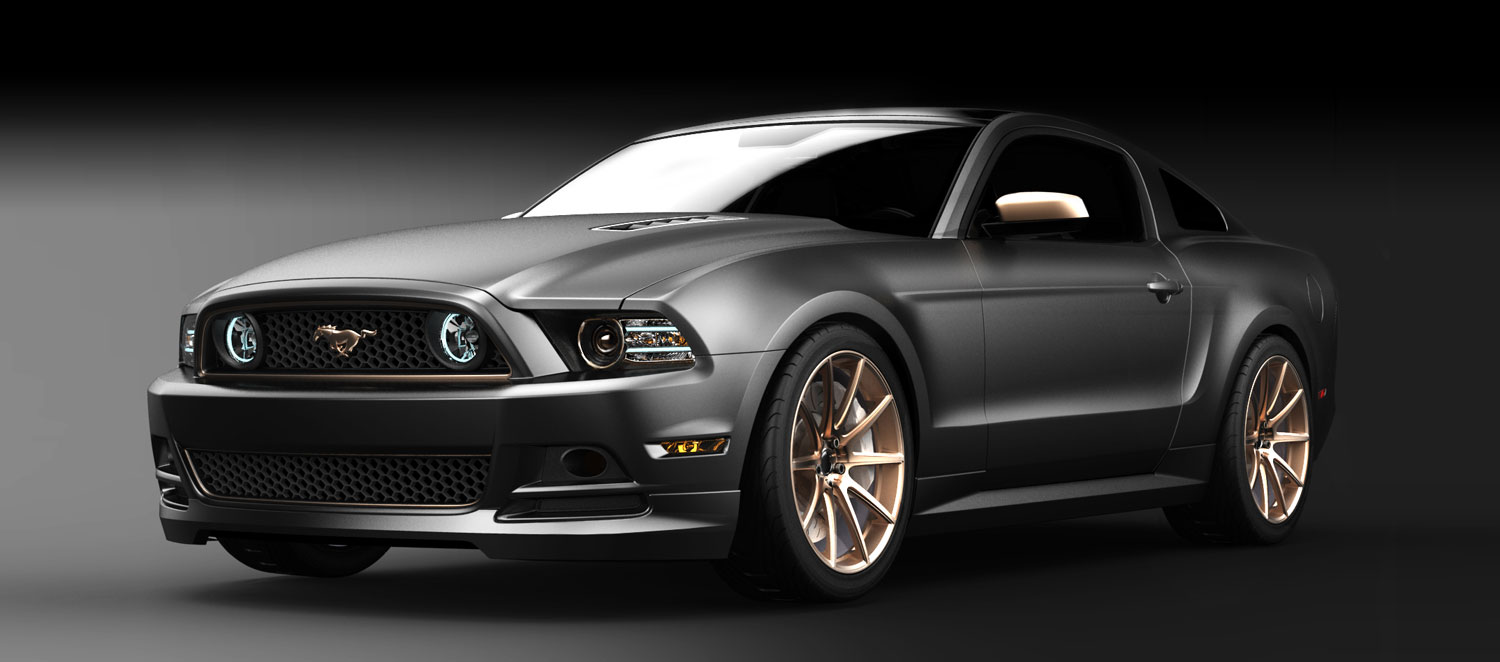
2013 Ford Mustang GT High Gear from SEMA is Highlighted on Latest Downshift

After an online contest, the 2013 Ford Mustang GT High Gear Concept won the votes as the first-ever SEMA Mustang to be designed and built exclusively by women. In this episode of The Downshift, we take a look at the team of women who took the 2013 Ford Mustang GT High Gear from concept to reality.


2013 Ford Mustang GT High Gear right front

2013 Ford Mustang GT High Gear left front

2013 Ford Mustang GT High Gear front three quarter

2013 Ford Mustang GT High Gear front three quarter high

2013 Ford Mustang GT High Gear front three quarter

2013 Ford Mustang GT High Gear interior


About 40 women from the SEMA Businesswomen’s Network participated in the project. Some of the women who participated in the build — including Ford designer Jennifer Seely who sketched the original concept — share their experience working together on the High Gear Mustang GT and the challenges they face in a male-dominated industry.

Vic Edelbrock was among the many support staff members for the project as an Edelbrock supercharger was among the performance-enhancing parts added to the High Gear Mustang GT. Outside, matte black paint and a rose-gold satin chrome finish was used on the wheels and other exterior trim. The rose-gold chrome finish carried over to the interior, which also featured leather seats wrapped in quilted suede.

Check out the video below to see highlights of the 2013 Ford Mustang GT High Gear build.

Articles Source : Motortrend

Friday, 1 March 2013

Final C6 Corvette built in Bowling Green

With all of the attention given to the 2014 Chevrolet Corvette Stingray lately, you could be forgiven for thinking that it's already well along in production, yet tooling up for the new C7 has only just begun. In fact, production of the outgoing C6 generation in Bowling Green, Kentucky just halted on Thursday.


As the C6 has aged, production numbers have predictably ebbed along with demand, but this year, the addition of the 427 and 60th anniversary models resulted in an uptick in vehicles built – this, despite a model year shortened by around 25 percent to accomodate the new model changeover. The final C6 Corvette ever, No. 13,466 built this year, was a white 427 Convertible destined for the General Motors Heritage Center museum. The car's 7.0-liter V8 heart was assembled by Corvette chief engineer Tadge Juechter himself.

In total, Bowling Green pushed out 215,100 C6 Corvettes over nine years. If you're still a C6 fan at heart and are hoping to get a good deal on a phase-out model, step lively – Chevrolet reportedly had about 6,100 unsold units, which Autoweek suggests is good for around five and a half months of supply at the model's current sales rates. Given that demand will likely slacken even further as the C7 draws closer, that should be a big enough stockpile to keep dealers satisfied until 2014 Stingrays begin showing up on their forecourts.

Chevrolet Corvette Stingray Excitement Speeds into Bowling Green

Yesterday, at 8:04 a.m., the last 2013 Corvette came off the line at the Bowling Green Assembly Plant. The celebration was short lived, as less than 30 minutes after the last car was built, workers began remodeling the plant to prepare for the launch of the all-new 2014 Corvette Stingray.

A total of 215,100 sixth-generation "C6" Corvettes were made at Bowling Green since production began in 2005, the last of which was the exclusive 2013 Corvette 427 Convertible Collector Edition outfitted with the 60th Anniversary design package. This package boasts an Arctic White exterior and a Blue Diamond leather-wrapped interior with suede-microfiber accents.

At the heart of the 427 Convertible is the 7.0-liter (427 ci) LS7 aluminum-block V8, which is handcrafted by skilled engine craftsmen at the GM Performance Build Center. For the LS7 destined for the last C6 produced, the engine was built by Corvette executive chief engineer Tadge Juechter.

The last C6 Corvette will join other historic General Motors vehicles at the GM Heritage Center in Warren, Mich.

"Leading up to the production of the last C6 has been all business," said Bowling Green plant manager Dave Tatman. "We take our job seriously and consider it the privilege that it is. But you can't do what we do and not get emotionally attached to the car."

Even as the team celebrated building the last C6, Tatman said there has been a great deal of anticipation and excitement toward building the all-new Stingray.

"The last C6 rolls off the line at 8:04 a.m. and I'll have people in here at 8:30 a.m. to start tearing down and putting in new tools," Tatman said.

The task will require that 120 workers take just four weeks to turn the Bowling Green plant around, completing a job that usually takes months to accomplish. All employees are slated to return to work on March 25, where they will learn the entirely new process required to build the Stingray.

Bowling Green Assembly, which hosts up to 50,000 visitors a year, is currently closed to the public to facilitate the remodeling of the line. Tatman said he plans to reopen the plant to outside tours as soon as possible, knowing that everyone is excited to see this new generation of Corvette built.


2013 Mini Countryman JCW ALL4 Dakar

Success in motor sport can be measured not only in titles and trophies, but also in an extra spike in driving fun out on the road. At least that's the message from the MINI John Cooper Works Countryman ALL4 Dakar Winner 2013. MINI and John Cooper Works have launched this special-edition model to celebrate their triumph in the Dakar Rally 2013, the French duo of Stéphane Peterhansel and Jean-Paul Cottret piloting their MINI ALL4 Racing to overall victory in the world's toughest rally event for the second year in a row. The MINI John Cooper Works Countryman ALL4 Dakar Winner 2013 is a limited-edition tribute to its rally inspiration - 11 examples of the car will be built, reflecting Peterhansel's 11 Dakar wins. Exclusive design and equipment features showcase both the thrill of title-winning race performance and the euphoria surrounding this latest Dakar victory with authentic élan.

2013 mini countryman jcw fd

2013 mini countryman jcw fd

2013 mini countryman jcw fd

2013 mini countryman jcw fd

2013 mini countryman jcw fd

2013 mini countryman jcw fd

2013 mini countryman jcw fd

The new special edition is based on the MINI John Cooper Works Countryman, the brand's first model to combine race-bred powertrain and chassis technology with the all-wheel-drive system that has just proved its mettle once again in rally action. ALL4 serves up optimum traction and directional stability in all weather and under-wheel conditions, not to mention providing a noticeable increase in agility through dynamically taken corners. And it wasn't only in the MINI ALL4 Racing that this variable distribution of power between the front and rear axle maintained irresistible forward-surging momentum in the Dakar Rally 2013: ALL4 also enabled the MINI Countryman support vehicle for the successful Monster Energy X-raid Team to carve an entertaining yet reliable passage through the 14 stages from the Peruvian capital Lima to Santiago de Chile.

The all-wheel-drive system channels the power from the 160 kW/218 hp turbocharged four-cylinder engine under the bonnet of the MINI John Cooper Works Countryman ALL4 Dakar Winner 2013 to all four wheels, as required, in any particular driving situation. Inspired by the eye-catching exterior colour of the Dakar-taming MINI ALL4 Racing, this matt black special edition comes with special bright green design features for the exterior and interior. These include Sport Stripes, which bear both the Dakar Rally winner's logo and the signature of victorious driver Peterhansel on the bonnet. Elsewhere, the green stripes along the car's flanks feature "MINI ALL4 Racing" lettering, while the driver and front passenger doors display the car number 302 and the names of the victorious pairing. The Dakar winner's logo can also be seen alongside the John Cooper Works badge at the rear of the car. Inside, the green contrast stitching for the gearshift lever gaiter and floor mats, and the green embroidered winner's logo on the head restraints, are complemented by green stripes for the black interior trim strip on the centre console. Added to which, a special-edition logo - complete with serial number - on the interior trim strip above the glove compartment, a John Cooper Works sports steering wheel and Gravity Black leather sports seats also feed into the cockpit's evocative sports car ambience. Auxiliary spotlights, bespoke side indicator surrounds and 19-inch light-alloy wheels in Cross-Spoke Crusher design add the finishing touches to the exclusive armoury of the MINI John Cooper Works Countryman ALL4 Dakar Winner 2013.

Stéphane Peterhansel's second Dakar Rally victory in the MINI ALL4 Racing was also the 11th of his career in the legendary event. To mark this achievement, the MINI John Cooper Works Countryman ALL4 Dakar Winner 2013 will be produced in a limited run of 11 units and sold exclusively in Peterhansel's home country of France.

Related Posts Plugin for WordPress, Blogger...